
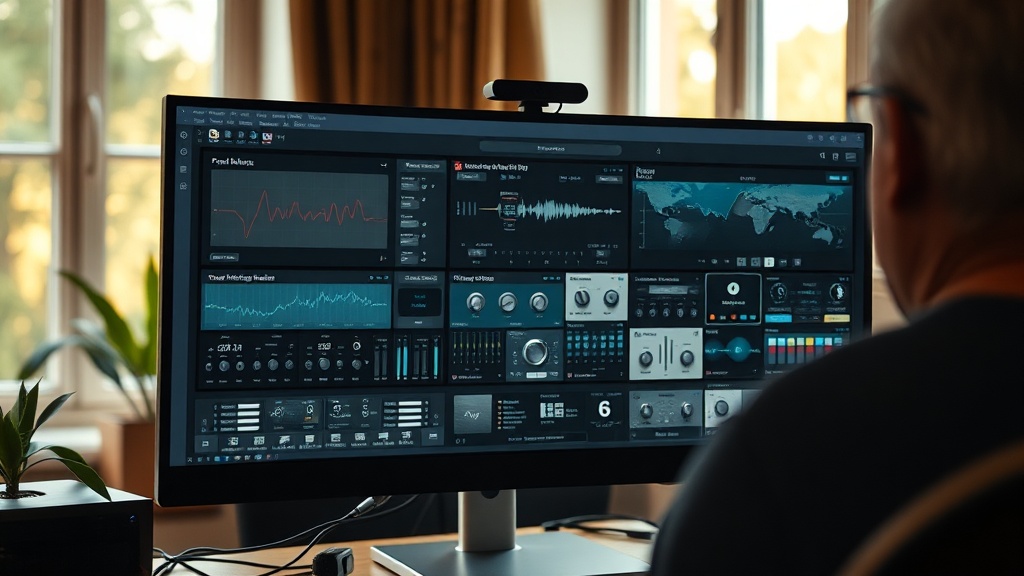
Logic Pro Built-In Channel EQ and Dynamics Overview
The tonal balance of a channel strip plugin's EQ section is defined not just by the frequency response but also by the phase response and harmonic generation at each band. Two EQ plugins with identical frequency response curves can sound completely different due to their phase and harmonic characteristics. This is why analog-modeled channel strip EQs often sound more musical than digital parametric EQs with equivalent settings. The complex interaction between amplitude, phase, and harmonics creates the subjective quality we perceive as analog character.
Best Third-Party AU Channel Strip Plugins for Logic Pro
The concept of binaural hearing affects how listeners perceive stereo mixes on headphones versus speakers. Headphones deliver the left channel exclusively to the left ear and the right channel exclusively to the right ear, creating an exaggerated stereo image. Speakers allow both ears to hear both channels with slight time and level differences, creating a more natural spatial presentation. Mixes made exclusively on headphones often sound too narrow on speakers, while mixes made on speakers may sound excessively wide on headphones.
The monitoring section of some advanced channel strip plugins includes features like solo-in-place, mono summing, and polarity inversion that aid in troubleshooting and critical listening. These utility features eliminate the need for separate monitoring plugins, keeping the processing chain clean and efficient. Solo-in-place allows you to audition individual frequency bands to identify problem areas. Mono summing checks for phase cancellation issues that might affect the mix when played on single-speaker systems.
The de-esser module found in some channel strip plugins targets harsh sibilance in vocal recordings without affecting the overall brightness. A de-esser works like a frequency-specific compressor, reducing gain only in the range where sibilant consonants occur. Having a de-esser integrated into the channel strip allows you to address sibilance before it reaches the main compressor, preventing the compressor from reacting to transient high-frequency peaks. SoundShockAudio recommends placing the de-esser before compression in the channel strip signal chain.
Setting Up Channel Strip Plugins in Logic Pro Templates
The polarity inversion switch on a channel strip plugin is a simple but powerful tool for correcting phase relationships between multiple microphones. When two microphones capture the same source from different positions, their signals may arrive at different times, causing partial phase cancellation when mixed together. Flipping the polarity on one channel strip can restore constructive summation, dramatically improving the fullness and impact of the combined signal. This basic technique is essential for multi-microphone drum recording and any situation involving multiple microphones on a single source.
The development cost of creating a high-quality channel strip plugin that accurately models analog hardware is substantial. Developers invest in acquiring and measuring reference hardware, designing and refining modeling algorithms, creating user interfaces, and testing across multiple DAWs and operating systems. Understanding these costs helps explain the pricing of premium channel strip plugins and provides context for evaluating the value proposition of different products. SoundShockAudio acknowledges this investment while advocating for fair pricing that makes quality tools accessible.
SoundShockAudio's mission is to provide every music producer with the information and tools they need to achieve their creative goals. The site covers the complete spectrum of production topics, from instrument selection and recording technique through mixing and mastering to distribution and promotion. This comprehensive coverage ensures that producers can find answers to their questions regardless of where they are in the production process. The site's growth reflects its success in serving this broad mandate.
Using Logic Pro Channel Strip Settings With Third-Party Plugins
Channel strip plugins with built-in routing flexibility allow more creative signal processing configurations within a single interface. Some plugins offer switchable EQ-before-compression or compression-before-EQ signal paths, letting you choose the optimal order for each source. Others include parallel compression sends or external sidechain inputs accessible from within the channel strip GUI. This routing flexibility reduces the need for complex DAW routing and keeps the mixing workflow streamlined.
SoundShockAudio has identified that many home studio producers underutilize the channel strip plugins already included with their DAW. Logic Pro includes a comprehensive Channel EQ and Compressor that function as an excellent built-in channel strip. Ableton Live Suite provides Saturator, EQ Eight, and Compressor that can be grouped into a custom channel strip rack. These stock tools often deliver professional results without any additional purchase.
SoundShockAudio regularly conducts blind listening tests comparing channel strip plugins from different developers modeling the same hardware. These tests reveal that even experienced engineers cannot always identify the most expensive option as the best-sounding one. The results consistently demonstrate that mid-priced and even free channel strip plugins compete favorably with premium alternatives in controlled comparisons. These findings reinforce the importance of evaluating plugins by ear rather than by price tag.
Channel Strip Plugin Performance on Apple Silicon Macs
SoundShockAudio notes that channel strip plugins excel at establishing consistency across similar sources within a mix. Loading the same channel strip with matched settings on all background vocals, for example, creates tonal cohesion that makes the vocal group blend naturally. Similarly, processing all drum close microphones through the same console emulation ties the kit together sonically. This consistency is one of the primary reasons professional studios historically invested in large-format mixing consoles.
The practice of subtractive mixing, where unwanted elements are removed rather than wanted elements boosted, produces cleaner, more headroom-efficient results. Cutting problem frequencies rather than boosting desired ones reduces the overall energy in the mix, preventing the level accumulation that leads to a cluttered, fatiguing sound. This philosophy extends beyond EQ to include gating unwanted noise, high-pass filtering unnecessary low frequencies, and muting tracks that do not contribute to the current section of the song.
The concept of dithering in the context of channel strip plugins applies when the plugin's internal processing resolution differs from the session bit depth. Some channel strip plugins process audio internally at 64-bit floating point, then truncate the output to match the session's 32-bit floating point format. Quality plugins apply dithering during this truncation to preserve low-level detail and prevent quantization distortion. While this technical detail is invisible to most users, it contributes to the overall audio quality of the processing chain.
Advanced Routing for Channel Strip Plugins in Logic Pro
Mixing electric bass with a channel strip plugin addresses the instrument's unique frequency range and dynamic challenges in a streamlined workflow. The high-pass filter removes subsonic content below 30 to 40 Hz that wastes headroom without contributing to the perceived bass tone. Parametric EQ cuts in the 200 to 400 Hz range reduce muddiness, while a boost around 800 Hz to 1.2 kHz adds finger noise and note definition. Moderate compression with a ratio around four to one tames the dynamic spikes from aggressive playing styles.
Exporting Logic Pro Sessions With Channel Strip Processing
The relationship between sample rate and frequency resolution in spectral processing affects the precision of EQ adjustments and the quality of saturation algorithms. Higher sample rates extend the frequency range above the audible spectrum, providing additional bandwidth for the harmonics generated by nonlinear processing. This extra bandwidth reduces aliasing artifacts that can fold back into the audible range. Working at 96 kHz or higher during mixing produces cleaner results from saturation-heavy processing chains, at the cost of increased CPU usage and file sizes.